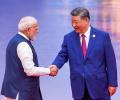
For India, China's Indian Ocean power projection, maritime domain awareness, dual-use ports, underwater surveillance, antisubmarinewarfare, naval exercises with Pakistan, pose considerable pressure, depleted India's strategic depth and marginalises Indian role, points out Srikanth Kondapalli.

The US has seized an oil tanker, 'Skywave', linked to Iran in the Indian Ocean, as part of efforts to disrupt Iran's oil shipments and enforce sanctions. The vessel was part of a network transporting sanctioned Iranian crude oil, with the seizure occurring amid heightened tensions between Washington and Tehran.

US Secretary of War Pete Hegseth praised India's military modernisation efforts at the Shangri-La Dialogue in Singapore, highlighting its growing industrial and logistics capacity.

Amid rising tensions, Iran reportedly launched ballistic missiles toward a US-UK military base, prompting concerns about regional stability and the potential for escalating conflict in the Middle East.

The Indian National Centre for Ocean Information Services (INCOIS) has issued a swell surge warning for coastal areas of Kerala, south Tamil Nadu, and Lakshadweep islands for August 19-20. High period swells from the southern Indian Ocean are expected to cause surging waves and inundation in low-lying regions, prompting advisories for fishermen and coastal residents to exercise caution and suspend recreational activities.

'India is trying to project that it can engage with the world in a different way too.'
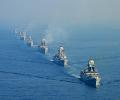
A parliamentary panel on external affairs has expressed concern over China's growing presence and influence in the Indian Ocean Region, citing risks to India's national security and strategic interests. The panel also highlighted the strengthening China-Pakistan naval nexus as a cause for concern.

A new report suggests China's maritime vulnerability lies in the Strait of Hormuz, not Malacca, creating strategic competition in the Indian Ocean.
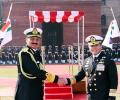
India's Navy Chief Admiral Dinesh K Tripathi has stated that India is fully aware of China's increasing presence in the Indian Ocean Region, with 6-8 Chinese naval ships present at any given time. Admiral Tripathi emphasized that India knows "who goes where", suggesting strong maritime domain awareness, and has not allowed China to operate in areas of Indian interest. He also highlighted China's supply of maritime equipment to Pakistan, including submarines, which India is actively addressing to ensure its maritime security and trade.

Japan is deepening its defence relationship with India while simultaneously expanding its economic, infrastructure and security engagement with countries around India -- particularly Bangladesh. The result is an emerging Japanese conception of South Asia in which India remains the strategic anchor, but the geography surrounding India is becoming increasingly important, points out Varun Arya.

Two commercial vessels, an oil tanker and a cargo ship, carrying a total of 22 Indian nationals, were hijacked by armed pirates in separate incidents off Yemen and Somalia. All Indian crew members on both vessels are reported to be safe, according to the latest information from the shipping ministry and the External Affairs Ministry.

India cannot choose its geography and devise regional strategies to dovetail into the Western Indian Ocean hypothesis conceived in the Pentagon, argues Ambassador M K Bhadrakumar.

Scientists at the ICAR-CMFRI have identified a new species of deep-sea fish, named Cyttopsis indica (Indian dory), in the Arabian Sea off the Kerala coast. This discovery, based on specimens collected from the eastern Lakshadweep Sea, corrects a long-standing taxonomic misidentification and highlights the rich marine biodiversity of India's southwest coast.

Gwadar is viewed as a critical pearl in China's maritime strategy as it would give a permanent logistical footprint near an important choke point - the Strait of Hormuz and the oil rich Persian Gulf, explains Commodore Venugopal Menon (retd).
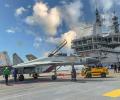
New Delhi's regional partners in restraining a belligerent China -- primarily the US, Japan, Australia and Singapore -- would like the Indian Navy to lock down the Indian Ocean Region, while the other partners can focus on deterring the PLA (navy) in the South China Sea, explains Ajai Shukla.

Hangors are effectively 'dead-on-arrival' with Pakistanis saddled with deadweights that displace around 3,000 tons. Last time it was near Vishakhapatnam. This time, barnacles will clog the Hangors in Karachi port itself, points out Dr Abhishek Puri.

Bangladesh summoned India's Deputy High Commissioner to convey "deep disappointment" after Dr. Zahed Ur Rahman, an adviser to the Prime Minister, was stopped and questioned by immigration authorities at Delhi's Indira Gandhi International Airport. The incident led to Rahman's decision to return home despite being cleared to proceed.

India is closely monitoring Sri Lanka's decision to offer foreign investors control of an airport near the China-controlled Hambantota port, as it could present a rare opening for Indian firms seeking strategic footholds in the Indian Ocean.

In many ways, 17th century India occupied a position in the global economy comparable to that of the United States today. Just as millions of people now look towards America because of its economic opportunities, merchants, adventurers and trading companies once looked towards India.

RSS chief Mohan Bhagwat stated that a true Hindu believes in the unity of humanity and that all religious paths lead to the same goal, asserting that 'if any Hindu thinks that there should be no Muslim in Bharat, he will not remain Hindu'.

The monthly average rainfall over India is expected to be below normal during July, the India Meteorological Department said on Tuesday in its monthly forecast.

India's top 400m runners, including Vishal Thennarasu Kayalvizhi and Jay Kumar, view the upcoming Commonwealth Games in Glasgow as a more challenging competition than the Asian Games. They believe the higher standard of competition, especially from Australia and England, will serve as an ideal proving ground to improve their performance and achieve personal bests ahead of the continental showpiece.
India's top 400m runners, including Vishal Thennarasu Kayalvizhi and Jay Kumar, view the upcoming Commonwealth Games in Glasgow as a more challenging competition than the Asian Games. They believe the higher standard of competition, especially from Australia and England, will serve as an ideal proving ground to improve their performance and achieve personal bests ahead of the continental showpiece.

External Affairs Minister S Jaishankar affirms India's self-determined and 'unstoppable' rise, emphasising the nation's strategic growth and role in the Indian Ocean region amid evolving global dynamics.

A maiden Test century is never just about three figures. It is a reflection of patience, perseverance, self-belief and the courage to wait for the right moment.

Brazilian aerospace company Embraer has secured type certification from India's aviation regulator, DGCA, for three of its commercial jets (E195-E2, E190, and E195). This approval, alongside an existing certification for its E175 jet, paves the way for Embraer to expand its presence in India's regional aviation market, supported by a strategic MoU with Adani Defence & Aerospace for a Final Assembly Line in Dholera, Gujarat.
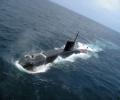
China has deployed a fleet of underwater drones called Sea Wing (Haiyi) glider in the Indian Ocean, which can operate for months on end and make observations for naval intelligence purposes, according to defence analyst HI Sutton.
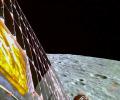
NASA has invited ISRO to join its ambitious Moon Base mission to establish a permanent lunar outpost near the Moon's South Pole, aiming for scientific discoveries and future deep space exploration. This invitation follows discussions at the Civil Space Joint Working Group meeting in Bengaluru, where both nations also advanced cooperation under the Artemis Accords and the TRUST initiative.

Defence and strategic experts on Monday said that China's posturing in the Indian Ocean will disturb stability and peace in the region.
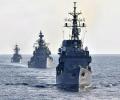
The Indian Navy is also ramping up its operational cooperation with various friendly naval forces like the United States Navy and Japan Maritime Self Defense Force in view of the fast evolving regional security landscape, they said.

With over 75 per cent indigenous content, the frigate is among the most self-reliant frontline warships built in India.

The harsh truth is that the US is no longer a reliable partner, cautions Ramesh Menon.

The 23rd Commonwealth Games opened in Glasgow with a vibrant ceremony at the OVO Hydro, blending Scottish heritage with modern performances. King Charles III declared the Games open, emphasising a message of sustainability, particularly regarding plastic pollution in oceans. The event showcased a new, more compact model for the Games, focusing on existing venues and integrated Para sports, following Glasgow's role as a step-in host.

Beijing clearly intends to extend the China-Myanmar Economic Corridor to Bangladesh as part of its larger Maritime Belt and Road Initiative to boost its Indian Ocean presence.

Prime Minister Narendra Modi and Indonesian President Prabowo Subianto have significantly advanced the India-Indonesia Comprehensive Strategic Partnership, securing crucial agreements on defence, critical minerals, and maritime security, including BrahMos missile supply and Sabang port development.

'The flip side of this is that he won't hesitate to call out India if he thinks its policies are hurting US economic interests or border US foreign policy goals.'

The 23rd Commonwealth Games opened in Glasgow with a vibrant ceremony blending Scottish heritage and a strong message of sustainability. King Charles III declared the Games open, highlighting efforts to combat plastic pollution. The event featured a unique indoor setting, an early athletes' parade including the Indian contingent, and diverse musical and cultural performances, setting a new precedent for the multi-sport event.

As China tries to gain a foothold in the Indian Ocean region, Prime Minister Narendra Modi on Thursday said India recognised that there are other nations around the world, with strong interests and stakes in the region.

The deployment seems to be more than what is needed.

If Iran and Oman choose to charge a fee for rendering services to vessels using their territorial waters, so be it. The US is indulging in an irrationally self-destructive act, notes Ambassador M K Bhadrakumar.
